Artist · Italian
Carla Accardi
1924–2014
Carla Accardi (born October 9, 1924, in Trapani, Italy – died February 23, 2014, in Rome) was one of the most significant Italian abstract painters of the twentieth century. After completing classical studies, she received private art training in 1943 and later studied at the Accademia di Belle Arti in Palermo and Florence. In 1946, she moved to Rome with the painter Antonio Sanfilippo, whom she later married. There, she joined the Art Club and became part of an influential circle of artists that included Pietro Consagra, Piero Dorazio, Achille Perilli, and Giulio Turcato. With them, she co-signed the manifesto of the Forma 1 group in 1947, advocating a synthesis of Marxist thought and abstract art.
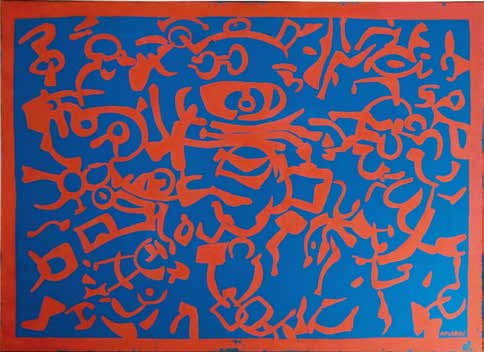
Her first solo exhibition took place in 1950 at the Galleria Numero in Florence. During the 1950s, Accardi developed a distinctive abstract language focused on signs and contrasts of black and white, aligning her work with the Art Informel movement. From 1954 to 1959, the critic Michel Tapiè promoted her work in several international exhibitions. In the 1960s, as a member of the Continuità group, she reintroduced color and explored optical effects and metropolitan imagery. Her experiments with transparent plastic supports created luminous, spatial paintings that became her signature style.
Accardi exhibited regularly at the Venice Biennale (1964, 1976, 1978, and 1988) and continued to evolve artistically through the 1980s, returning to canvas and exploring vibrant chromatic juxtapositions. She participated in major retrospectives, including The Italian Metamorphosis 1943–1968 at New York’s Solomon R. Guggenheim Museum in 1994. Elected to the Accademia di Brera in Milan in 1996 and a member of the Venice Biennale Commission the following year, Accardi achieved lasting recognition. Her works are held in prominent Italian collections such as the Galleria Nazionale d’Arte Moderna in Rome, the Castello di Rivoli, and the Palazzo Reale in Milan.
Collection
Works in the Collection