Artist · Dutch
Geer van Velde
1898–1977
Geer van Velde was a distinguished Dutch abstract painter who emerged as a significant figure in the post-World War II School of Paris. Born in Lisse, Netherlands, he initially trained as an apprentice house painter. In 1925, he moved to Paris, joining his older brother and fellow artist, Bram van Velde, to fully dedicate himself to the visual arts.
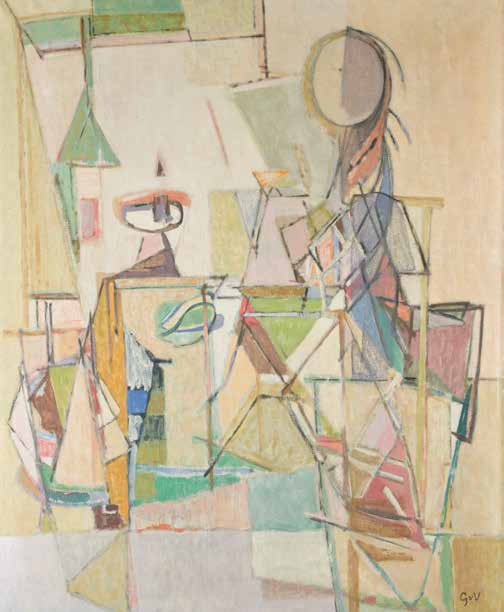
Van Velde’s early career was shaped by figurative work, strongly influenced by Expressionism and Cubism. However, after relocating to the south of France in 1938, his style underwent a profound transformation. He abandoned strict representation in favor of a deeply personal, lyrical abstraction. His compositions became a delicate dance of geometric forms, characterized by a masterful interplay of diffused light, space, and a muted, ethereal color palette.
A major breakthrough arrived in 1938 with a solo exhibition at Peggy Guggenheim’s London gallery, Guggenheim Jeune, which brought his vision to international attention. Settling later in Cachan, van Velde spent his remaining decades quietly refining his style. His art prioritized meditative stillness over dramatic gestures, securing his legacy as a master of serene, geometric abstraction.
Collection
Works in the Collection