Artist · French
Georges Mathieu
1921–2012
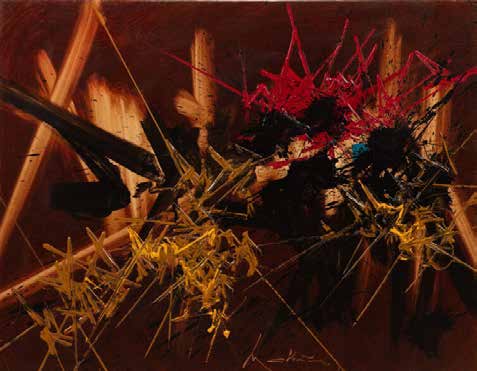
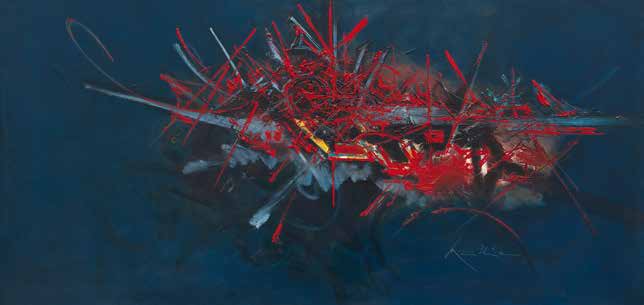
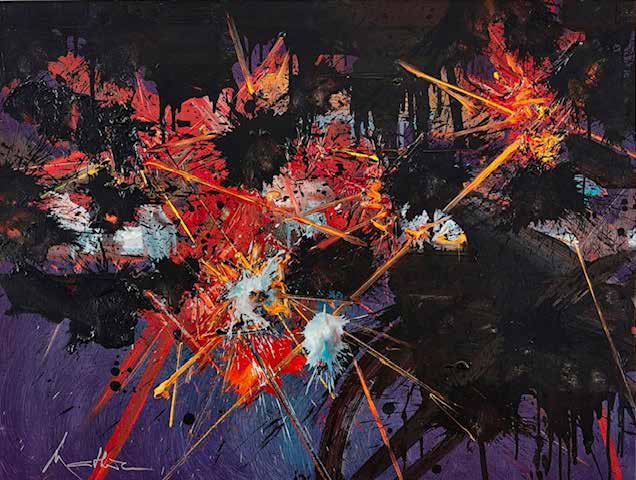
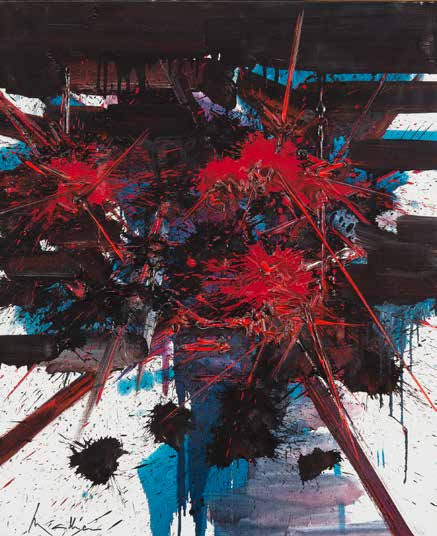
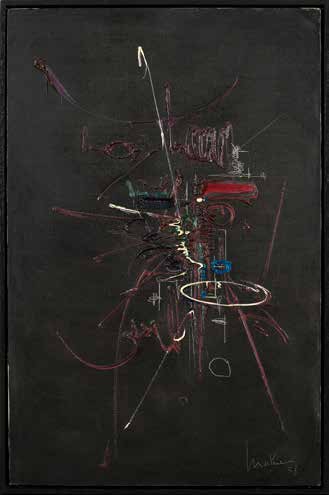
Georges Mathieu is associated with Tachism (French for stain-making), a style of painting practiced in Paris after World War II, and through the 1950s. Similar to Abstract Expressionist painting in the United States, Tachism is understood as emotional, intuitive and highly spontaneous, emphasizing the gestural and performative aspects of the act of painting.
Mathieu was born in Boulogne-sur-Mer in France, and studied philosophy and literature before devoting himself to painting.
After his first studies on realist landscape paintings and portraits, in 1944 he began to experiment with more abstract and expressive forms in his “lyrical abstractions.”
Mathieu’s work in the style of Tachism was part of the larger French postwar movement known as Art Informel, inspired by the instinctive, personal approach of contemporary American Abstract Expressionism and Action painting; Mathieu even sought to introduce Jackson Pollock to Europe at the end of the 1940s through organizing exhibitions of Abstract Expressionist and Art Informel works.
In the mid-1950s, Mathieu began to paint in front of several thousand viewers at a time in theatrical events, referring to both Action painting and to Happenings. In front of nearly 2,000 spectators, he created an array of 4 × 12 meters using no less than 800 tubes of paint.
In 1963, his “ Great Retrospective “ at the Modern Art Museum City of Paris, he finally reaches the official consecration.
On 7 May 1975, Georges Mathieu was elected member of the Academy of Fine Arts at Alfred Giess chair.
He died on June 10, 2012 in Boulogne- Billancourt.
Collection
Works in the Collection