Artist · French
Leopold Survage
1879–1968
Léopold Survage was a French painter born in Lappeenranta, Finland.
At a young age, Survage learned to play piano, then completed a commercial diploma in 1897. After a severe illness at the age of 22, Survage rethought his career and entered the Moscow School of Painting, Sculpture and Architecture.
Introduced to the modern movement through the collections of Sergei Shchukin and Ivan Morozov, he cast his lot with the Russian avant-garde and, by 1906, was loosely affiliated with the circle of the magazine Zolotoye runo. He met Alexander Archipenko, exhibiting with him in the company of David Burlyuk, Vladimir Burlyuk, Mikhail Larionov and Natalia Goncharova.
With Hélène Moniuschko, later his wife, he travelled to Western Europe, visiting Paris in July 1908. The couple eventually settled in Paris and first showed his work in France—at the urging of Archipenko—in the Salon d’Automne of 1911.
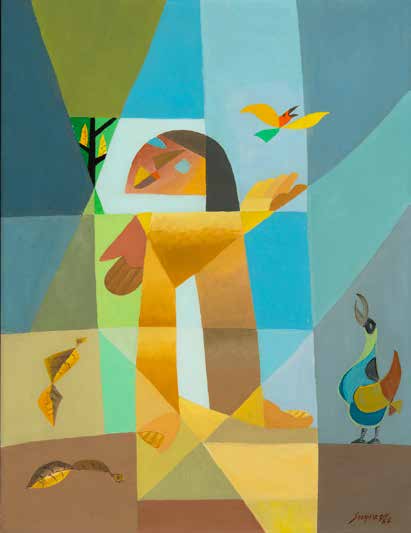
Survage later moved to Nice and, over the next eight years, produced highly structured oils and works on paper linked together by a series of leitmotifs, repeating groups of symbolic elements—man, sea, building, flower, window, curtain, bird—as if they were protagonists in a series of moving images.
By 1922, Survage had begun to move away from Cubism in favour of the neo-classical form. Although mainly a painter, he also produced stage, tapestry, and textile designs during this period (notably for the house of Chanel in 1933). Toward the end of the 1930s, as a result of his contact with André Masson, Survage became increasingly charmed by symbols and mysticism. The curvilinear forms that had previously dominated his compositions came, once again, under the control of geometric structure.
Survage was inducted into France’s Légion d’Honneur in 1963.
He died on 31 October 1968.
Collection
Works in the Collection