Artist · French-Hungarian
Victor Vasarely
1906–1997
Victor Vasarely is a preeminent painter known as the father of the Op Art movement.
He studied medicine at the Budapest University in his early 20s before abandoning his medical studies to go to the Muhely Academy, the center of the Bauhaus movement in Budapest. While studying there, he was influenced by the work of color theorist and artist Josef Albers, as well as the Constructivist methods promoted by artists such as Wassily Kandinsky.
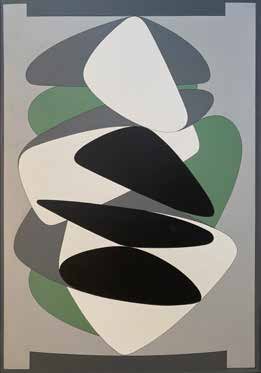
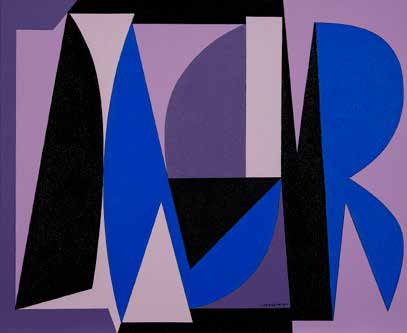
While Vasarely’s earlier work was concerned more with color theory, during the 1950s and 1960s his work became more focused on the optical potential of the two-dimensional surface. He began to use complex and colorful patterns to actively engage the viewer’s eye, and to convey a sense of kinetic energy across the two-dimensional surface.
Vasarely’s work was heavily influenced by his time spent at Breton Beach of Belle-Isle in France, which also prompted the creation of his prominent Belle-Isle series. This series displays an intrinsic concern with the internal geometry present in the natural world, a motif that Vasarely continued to explore extensively throughout his entire body of work.
His works present color, form, and pattern as a single interconnected element, a concept that was critical to the foundation of the Op Art movement and the production of his more mature works.
On 5 June 1970, Vasarely opened his first dedicated museum with over 500 works in a renaissance palace in Gordes (closed in 1996).
In the 1970s, he took a stab at industrial design with a 500-piece run of the upscale Suomi tableware by Timo Sarpaneva that Vasarely decorated for the German Rosenthal porcelain maker’s Studio Linie. In 1982 154 specially created serigraphs were taken into space by the cosmonaut Jean-Loup Chrétien on board the French-Soviet spacecraft Salyut 7 and later sold for the benefit of UNESCO.
Vasarely died age 90 in Paris on 15 March 1997.
Collection
Works in the Collection