Artist · Chinese-French
Zao Wou-Ki
1920–2013
Zao Wou-Ki, born in Beijing, China, was an internationally-renowned Abstract artist.
His role in the Lyrical Abstraction circle of postwar painters in France represented a juncture of Chinese and postwar European and American painting traditions.
Zao studied calligraphy in his childhood and, from 1935 to 1941, painting at the school of Fine Arts in Hangzhou, where he learned the techniques of traditional Chinese and Western painting. Nevertheless, he was most heavily influenced by European modernists Paul Cézanne, Henri Matisse, and Pablo Picasso.
He arrived in Paris in April 1948, acquainting himself with European Lyrical Abstraction, a movement of postwar French artists pursuing free-form expression through painting.
In 1949, he began making prints, publishing them accompanied by poems from celebrated poet Henri Michaux.
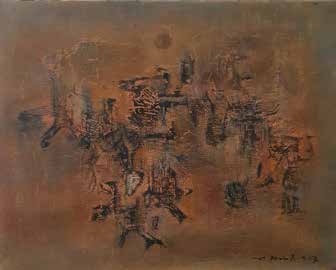
Upon discovering Paul Klee’s paintings in 1951, Zao began to incorporate ideograms into his paintings. Zao still painted figurative elements, however, and used titles for his works referencing actual objects, before definitively choosing an Abstract aesthetic in 1953, inspired by archaic Chinese characters.
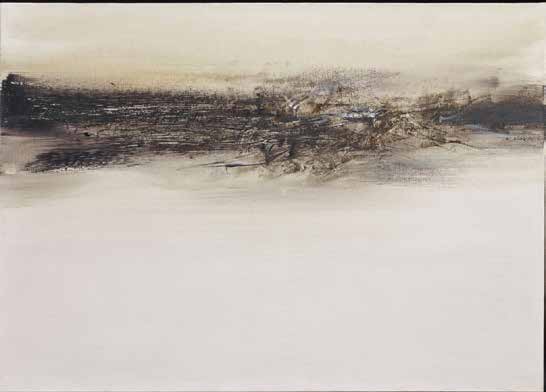
From the 1960s on, his paintings focused on space and movement, with forms resembling flowing streams or effervescent magmas; in the late 1960s as the illness of his second wife Chan May Kan worsened, the style of Zao’s paintings became more frenzied.
Zao was a member of the Académie des beaux-arts, and was considered to have been one of the most successful Chinese painters during his lifetime.
By the end of his life Zao had stopped producing new paintings due to health problems. He died on 9 April 2013 at his home in Switzerland.
Collection
Works in the Collection